

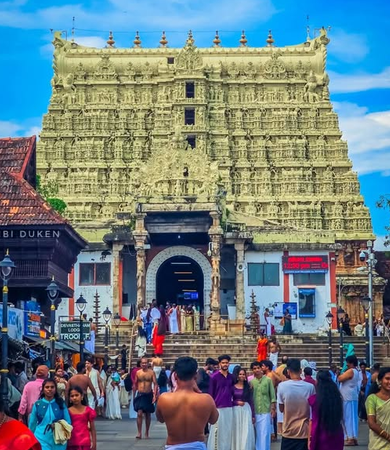
here Vishnu rests eternally on Adi Ananta, in divine Yoga Nidra.
A temple of unmatched sanctity, timeless rituals, and profound mystery—
the sacred heart of Kerala’s spiritual heritage.
“Anantam, Narayanam, Padmanabham”
Thiruvananthapuram, the capital city of Kerala is named after the presiding deity of the Sree Padmanabhaswamy Temple, who is also known as Anantha (one who reclines on the Serpent Anantha).
‘Thiruvananthapuram’ translates to the Land of Sree Anantha Padmanabhaswamy.
It was in 1750 that the kingdom of Travancore was dedicated to Lord Padmanabha by the then king Marthanda Varma. He vowed that the royal family will rule the State on behalf of the Lord and he and his descendants would serve the kingdom as Padmanabha Dasa or the Servant of Lord Padmanabha. Ever since the name of every Travancore king was preceded by the title Padmanabha Dasa. All donations offered by the kingdom of Travancore to Padmanabhaswamy were known as Thripadidanam. Even today the shrine is run by a trust headed by the erstwhile royal family of Travancore.
It was Marthanda Varma one of the most renowned erstwhile rulers of Travancore who did major renovations to the temple which gave it its present day structure and form. It was he who introduced the Bhadra Deepam and Murajapam festivals in the temple. Every six years the Murajapam (which literally means continuous chanting of prayers) festival, is still conducted in the temple.
The hallowed halls and sacred precincts of this magnificent temple have captivated devotees and visitors alike for centuries. Even today the Sree Padmanabhaswamy Temple is a testament to the rich legacy of the land.
It is also believed that the Sree Padmanabhaswamy Temple is located at a place considered to be one among the seven Parasurama Kshetras. There are also references to the temple in ancient texts like the Puranas, viz. the Skanda Purana and Padma Purana. The holy tank that stands close to the temple is called Padma Theertham, meaning the ‘lotus spring.’